




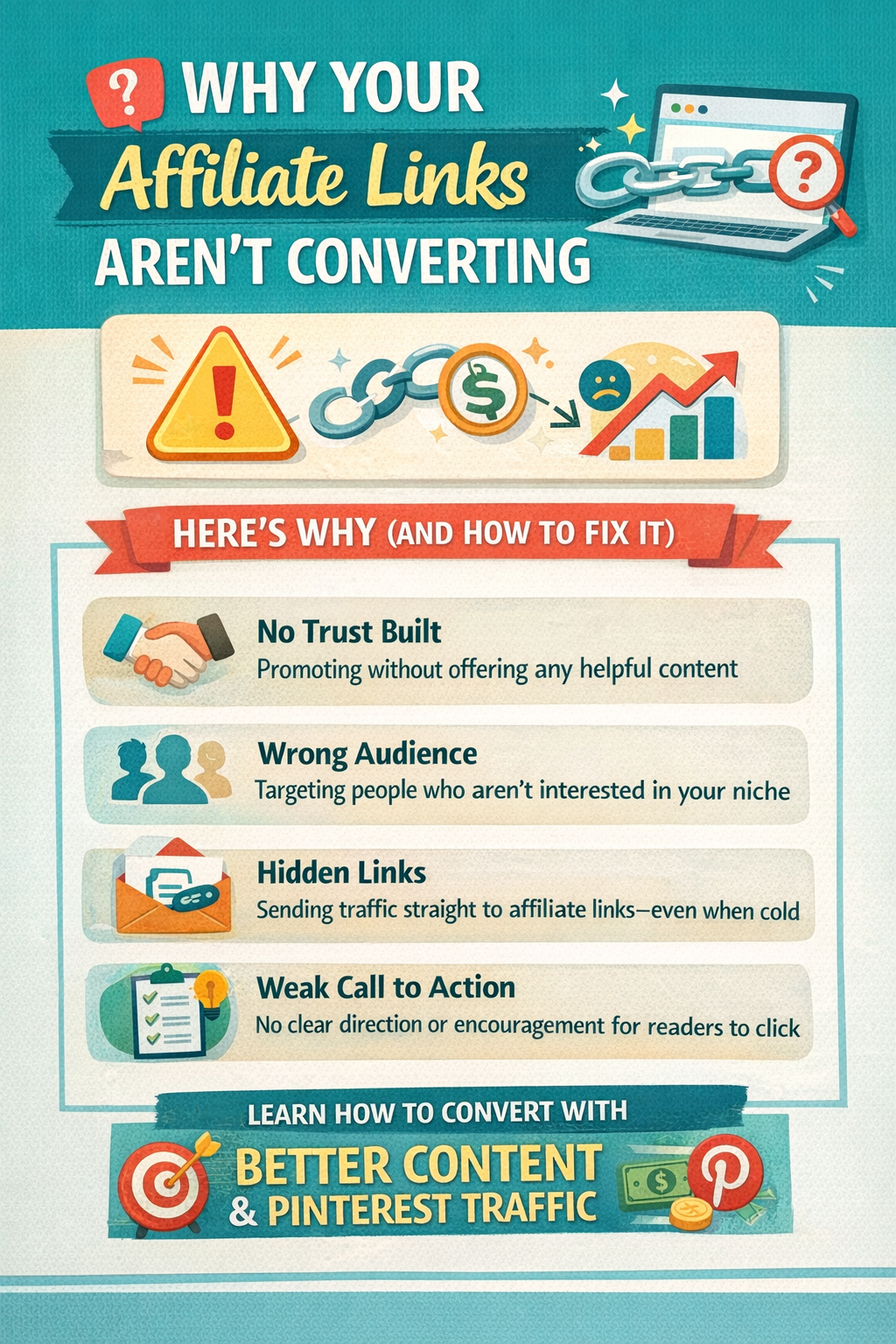
You’ve joined the affiliate programs, grabbed your unique tracking links, and sprinkled them across your website or social media. You wait for the commissions to roll in, but when you check your dashboard, it’s a sea of zeros.
It’s a frustrating rite of passage for many digital marketers. However, the gap between a link that gets ignored and one that generates passive income isn’t usually a matter of luck—it’s a matter of strategy.
If your affiliate links aren’t converting, it usually boils down to one of these seven fundamental mistakes. Here is how to identify them and, more importantly, how to fix them.
1. Lack of Trust and Authority
The internet is a skeptical place. If a visitor arrives at your site and feels like they are being “sold to” by a stranger who is just looking for a quick buck, they will bounce. People buy from those they trust.
Why does it happen:
If your content is purely promotional or if you haven’t established yourself as an expert in your niche, your recommendations carry no weight. If you recommend a high-end camera but your blog is full of low-quality, AI-generated travel tips, the disconnect is jarring.
How to fix it:
- The “Value First” Rule: Follow the 80/20 rule. 80% of your content should be purely helpful, educational, or entertaining with no strings attached. Only 20% should be promotional.
- Show, Don’t Just Tell: Use original photos and videos of you actually using the product. Case studies and personal results are the ultimate trust-builders.
- Transparency: Always include a clear affiliate disclosure. Ironically, being honest about earning a commission makes you more trustworthy, not less.
2. Poor Product Alignment
You might have 10,000 visitors, but if you are selling lawnmowers to people living in high-rise apartments, you won’t make a dime.
Why does it happen?
Many affiliates choose products based on the commission rate rather than the audience’s needs. A 50% commission on a $500 software package looks great on paper, but if your audience consists of hobbyist knitters, there is zero “Product-Market Fit.”
How to fix it:
- Create a Reader Persona: Who is your average reader? What are their pain points? What keeps them up at night? Only promote products that solve those specific problems.
- Audit Your Offers: Go through your top-performing posts. Are the links in those posts actually relevant to the topic? If you have a post about “How to Start a Garden,” link to seeds and shovels, not your favorite web hosting service.
3. The “Cringe” Hard Sell
Nothing sends a potential buyer running faster than “salesy” language. Phrases like “BUY NOW BEFORE IT’S GONE!” or “BEST PRODUCT EVER!!!” trigger a mental defensive mechanism in modern consumers.
Why it happens:
Inexperience often leads to over-enthusiasm. New affiliates feel they need to shout to be heard, but in the world of content marketing, a whisper (a subtle, helpful recommendation) is often more powerful than a scream.
How to fix it:
- Adopt a “Helpful Friend” Tone: Write as if you are recommending a product to a close friend. Use natural language.
- Focus on Benefits, Not Features: Don’t just list the technical specs. Explain how the product changes the user’s life.
- Feature: “This laptop has 16GB of RAM.”
- Benefit: “This laptop lets you edit 4K video without those annoying lag spikes, saving you hours of frustration.”
4. Friction in the User Experience (UX)
Sometimes the problem isn’t your content—it’s the journey the user has to take to get to the product. If your website is slow, cluttered, or confusing, you’ll lose the sale before the link is even clicked.
Why does it happen?
Long, “ugly” affiliate links filled with random strings of numbers can look suspicious to users. Furthermore, if your links are buried in a wall of text or hidden behind buttons that don’t appear clickable, nobody will find them.
How to fix it:
- Cloak Your Links: Use a plugin like Pretty Links (for WordPress) to turn
affiliate-site.com/products/12345?ref=xyzintoyourdomain.com/go/product. It looks cleaner and safer. - Optimize for Mobile: More than half of all web traffic is generated from mobile devices. If your affiliate buttons are too small to click with a thumb, you’re leaving money on the table.
- Visual Cues: Use “Call to Action” (CTA) boxes, buttons, and bold text to make your links stand out visually from the rest of the prose.
Look at our best products from Amazon.
5. Ignoring the “Intent” of the Keyword
Not all traffic is created equal. Understanding Search Intent is the difference between a high click-through rate and a high conversion rate.
Why does it happen:
There are four types of intent: Informational, Navigational, Commercial, and Transactional. If you place affiliate links in a purely informational post (e.g., “What is photosynthesis?”), The conversion rate will be abysmal because the user isn’t in a “buying” mindset.
How to fix it:
- Target Commercial Intent: Focus your affiliate efforts on “Best of” lists, “Product A vs. Product B” comparisons, and deep-dive reviews. These users are already at the bottom of the sales funnel—they just need a final nudge.
- Match the Link to the Stage: In an informational post, offer a lead magnet (like a free PDF). In a review post, offer the affiliate link.
6. The “One and Done” Mistake
Many bloggers write a review, hit publish, and never look at it again. They assume that one link at the bottom of the page is enough.
Why it happens:
There is a misconception that being subtle means being invisible. If a reader has to scroll through 2,000 words to find your recommendation, they probably won’t find it.
How to fix it:
- The Rule of Three: Place your affiliate link in three strategic locations:
- The Hook: Early in the post for people who want to buy immediately.
- The Meat: Inside the body of the content, linked to a specific benefit.
- The Conclusion: A final CTA for those who read the whole piece.
- Comparison Tables: For “Best of” posts, always include a comparison table at the very top. Many users want to see the “Top Pick” and click through without reading the full analysis.
7. Tracking the Wrong Data (or None at All)
If you don’t know which links are being clicked and which ones are converting, you are flying blind. You can’t fix what you can’t measure.
Why it happens:
Standard affiliate dashboards often show you total clicks but don’t tell you where those clicks came from. Did they come from your sidebar, your email list, or that blog post from 2022?
How to fix it:
- Use Sub-IDs: Most affiliate networks (like Amazon Associates or ShareASale) allow you to add tracking IDs to your links. Create unique IDs for different pages or placements.
- Heatmaps: Tools like Hotjar or Microsoft Clarity can show you exactly where users are clicking on your page. If they are clicking on an unlinked image of the product, link that image!
- A/B Testing: Try changing the color of your “Buy Now” button or the wording of your CTA. Sometimes a simple change from “Check Price” to “Get 20% Off” can double your conversions.
Summary Table: Problem vs. Solution
| The Problem | The Quick Fix |
| Low Trust | Add personal photos and an affiliate disclosure. |
| Bad Alignment | Only promote products that solve your audience’s specific problems. |
| Hard Selling | Focus on benefits and use a conversational tone. |
| Ugly Links | Use a link cloaker to make URLs look professional. |
| Wrong Intent | Focus on “Best of” and “Review” style content. |
| Hidden Links | Use buttons, tables, and multiple link placements. |
| No Data | Use Tracking IDs (Sub-IDs) to see what actually works. |
Conclusion
Making sales with affiliate marketing isn’t about tricking people into clicking; it’s about positioning the right solution in front of the right person at the right time. If your links aren’t converting, take a step back and look at your content through the eyes of a first-time visitor. Are you being helpful? Is the site easy to navigate? Do you actually believe in the product you’re promoting? Fix the user experience and the trust gap first, and the commissions will naturally follow.
Ultimately, affiliate links work best when they support the reader’s decision-making process. Looking at content formats like the top best headphones guides can help illustrate how trust-building information often performs better than aggressive promotion.